1. What Is Low-Noise BOPP Packaging Tape?
BOPP packaging tape generally uses a biaxially oriented polypropylene film backing with a pressure-sensitive adhesive. Unwinding noise is the sound heard as tape is dispensed; its level and character may vary with product and operating conditions.
The independent research discussed below calls for further investigation into the causes of unwinding noise. The reviewed evidence establishes no single mechanism for all tapes. A particular adhesive chemistry or release coating should not be assumed to make tape quieter.
“Low Noise,” “Silent,” “Quiet Unwinding” and “Smooth Unwinding” are product descriptions, not universal technical classifications. The reviewed sources establish no universal sound-pressure threshold. For finished product information, see BOPP carton-sealing tape.
Third-Party Product References and Trademarks
This article may refer to third-party manufacturers, brands, product names, trademarks, and published technical information solely to identify specific products and provide factual, product-specific examples for general informational and educational purposes.
All third-party names, trademarks, logos, and product references remain the property of their respective owners. Their inclusion does not imply any affiliation, partnership, authorization, sponsorship, approval, or endorsement between Yiran Tape and any referenced manufacturer or brand. Such references do not constitute a ranking, recommendation, or endorsement of any third-party product.
Any specifications, performance figures, application statements, or product descriptions attributed to a third party relate only to the specific product and source identified. They are manufacturer-specific references, not universal industry standards, and must not be interpreted as specifications, performance claims, or guarantees for Yiran Tape products or any other product.
Published values may vary depending on product version, test method, substrate, equipment, and operating conditions. Readers should consult the relevant manufacturer's latest technical documentation and independently verify product suitability under their actual application conditions, including representative testing where appropriate.
The mention of a third-party product does not indicate that Yiran Tape manufactures, owns, distributes, or is authorized to represent that product. No third-party product reference should be interpreted as evidence of a commercial relationship or technical equivalence with Yiran Tape products.
2. Unwinding Noise vs Unwind Force
Unwinding noise is acoustic; unwind force is the mechanical force needed to remove tape. They are different properties.
| Property | What it describes |
|---|---|
| Unwinding noise | Sound heard during unwinding; may be reported as sound-pressure level |
| Unwind force | Mechanical force required to unwind tape |
| Peel adhesion | Force required to separate bonded tape from a surface |
| Holding power | Resistance to movement under sustained loading |
| Tensile strength | Resistance of the backing to breaking under tension |
ASTM D3811/D3811M-21a, Standard Test Method for Unwind Force of Pressure-Sensitive Tapes, addresses mechanical unwind force. It is not an acoustic noise measurement method. A favorable unwind-force result does not establish quiet unwinding. Request acoustic evidence separately. See the BOPP tape unwind force guide.
3. What the IFA Research Actually Found
IFA Project 4240, "Investigation of unwinding noise of different industrially used self adhesive tapes," examined tape unwinding noise in a laboratory. The research was conducted by the German Social Accident Insurance Institution for the Foodstuffs and Catering Trade (BGN) in conjunction with the Institute for Occupational Safety and Health of the German Social Accident Insurance (IFA), and was completed in March 2023.
The project examined 13 industrial adhesive tapes, with five rolls per product and test speed, at two unwinding speeds. A microphone was positioned 50 cm axially from the tape. Sound-pressure levels, spectra and sound level-time curves were recorded. The public summary does not state the exact speeds.
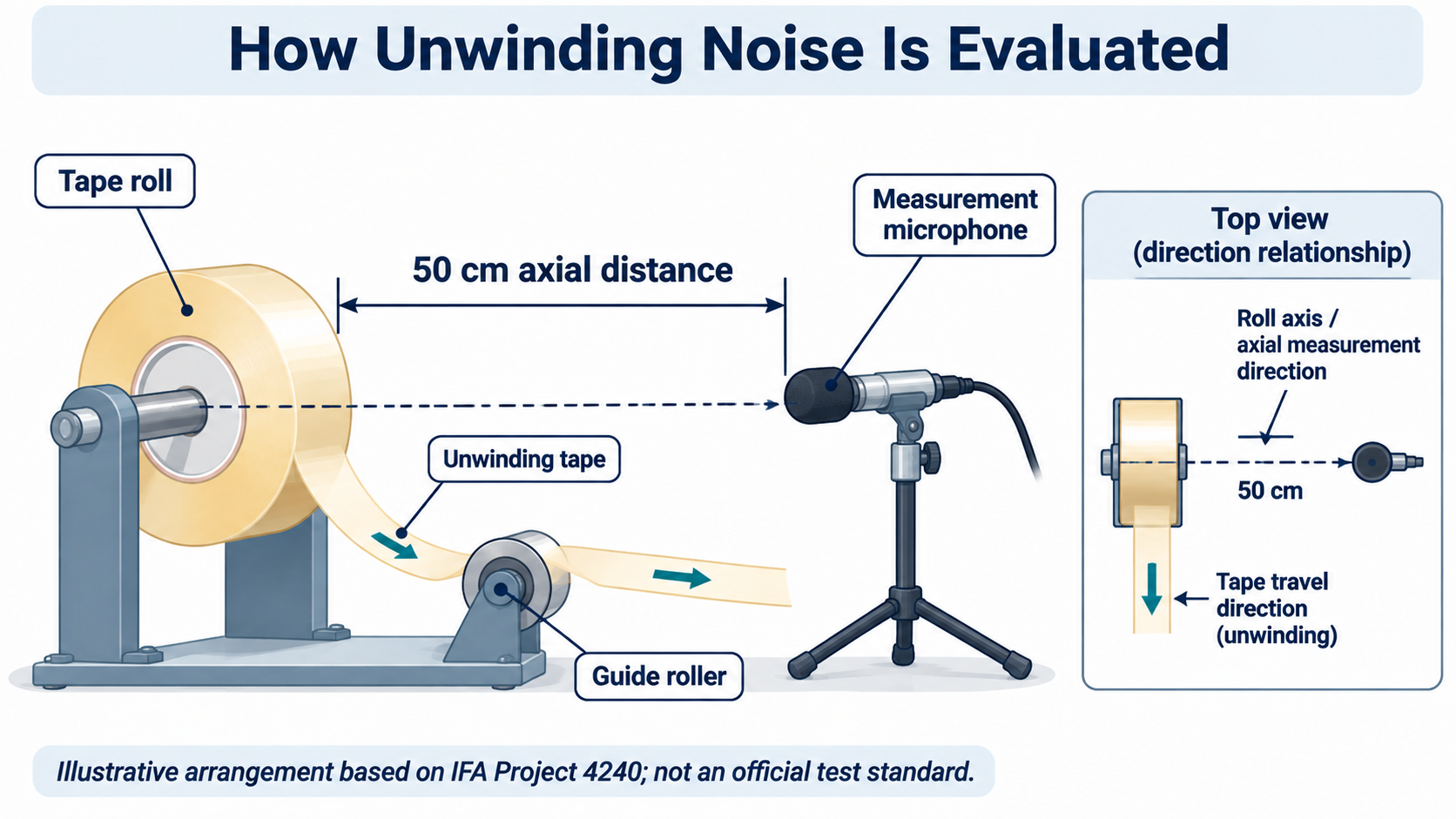
The study observed approximately 15 dB sound-pressure-level differences between tested tapes. Manufacturer claims about quiet unwinding or Low Noise labelling were not supported by the project's direct comparison.
This observation applies only to tested products. It does not mean every Low Noise BOPP tape reduces noise by 15 dB, every conventional tape is 15 dB louder, or 15 dB is a universal threshold. The study is not a BOPP-only ranking.
The research identified a lack of a uniform measurement method or specification for this purpose at the time and called for further investigation and validation. See IFA Project 4240 and the English DGUV Focus on IFA No. 0447.
4. Why Low-Noise Claims Are Difficult to Compare
Low Noise claims cannot be compared reliably without disclosed test conditions. Before comparing dB values, buyers should check whether the arrangements were comparable.
| Information to check | Why it matters |
|---|---|
| Method and instrument | Shows how the result was obtained |
| Microphone position and distance | Defines measurement geometry |
| Background noise and environment | Helps interpret the recorded sound |
| Unwinding speed and dispenser | Identifies operating conditions |
| Roll dimensions and product version | Identifies the tested configuration |
| Sample quantity and batch | Shows what the result represents |
The IFA 50 cm microphone position describes its setup, not a universal buyer-test requirement.
General machinery-acoustics standards provide broader measurement frameworks. ISO 11200:2014 gives general guidance on using basic standards to determine machinery noise-emission sound-pressure levels. ISO 11201:2010 specifies a method for determining emission sound-pressure levels at a workstation and other specified positions under defined conditions.
Both are general machinery-acoustics standards. Neither is a dedicated BOPP tape unwinding-noise test method. The reviewed evidence does not establish a universal dedicated method or Low Noise dB threshold for BOPP packaging tape. Two dB results are not automatically comparable when their methods, positions or operating conditions differ.
5. Tape Construction and Application Conditions
Buyers may need to identify the BOPP backing, adhesive system, available release-coating information, roll dimensions and dispensing method. Hand and machine dispensing may involve different conditions; record application speed and environment where relevant.
Temperature is another operating condition to record where relevant, particularly in applications involving deep-freeze packaging. IFA identified temperature as a factor for future studies. Buyers should therefore consider their actual operating environment rather than assume that the reported comparison covers every temperature condition.
IFA identified gaps in information about release agents or coatings and bonding agents or primers. This supports requesting construction details, not claiming that one chemistry universally produces quieter tape.
Manufacturer pages illustrate product-specific terminology:
- tesa 4024 PV4 Next Generation is described by tesa as a silent BOPP carton-sealing tape with water-based acrylic adhesive and smooth, low-noise unwinding. This is the manufacturer's description, not independent acoustic verification. Its published values are manufacturer-provided average or representative values and should not be generalized.
- tesa 60433 product information identifies good low unwinding force while listing silent unwinding as “No.” This product-specific example shows that low unwind force and silent unwinding are separate characteristics; it is not a direct acoustic comparison.
- Scapa 1253 Low Noise BOPP Packaging Adhesive Tape is described by Scapa as a low-noise BOPP tape. Its technical data sheet provides product-specific information, but the reviewed TDS does not provide an acoustic result or dedicated noise-test method.
- YG Group Low Noise Water-Based OPP Tape is promoted as a low-noise product. Its release-coating explanation remains an attributed manufacturer statement, not a universal, independently established mechanism.
These examples are not a ranking: product descriptions, construction details and acoustic results are different evidence types. See hand roll and machine roll BOPP tape.
6. What Buyers Should Request from Suppliers
For the exact product, buyers can request:
| Information to request | Purpose |
|---|---|
| Exact product name and version | Identifies the product being evaluated |
| BOPP backing and adhesive description | Identifies the finished-tape construction |
| Finished-roll width and length | Establishes the roll configuration |
| Intended dispensing equipment | Distinguishes manual and machine applications |
| Intended unwinding speed | Establishes the operating condition |
| Confirmation of whether an acoustic test was conducted | Separates a marketing claim from measured evidence |
| Measured acoustic result and unit, if available | Provides the reported result |
| Measurement method and test environment | Supports interpretation and comparison |
| Microphone position and distance | Identifies the measurement geometry |
| Sample quantity and batch identification | Establishes the sample basis |
| Supporting test report or technical documentation | Provides traceable evidence |
| Adhesion and other relevant performance information | Helps evaluate overall packaging suitability |
These are buyer recommendations, not ASTM or IFA requirements. If no acoustic report is available, record the gap rather than treating a Low Noise label as a measured result. A representative application trial may provide application-specific information.
7. Balancing Noise and Packaging Performance
Noise is only one selection factor. Also consider carton adhesion, backing strength, application consistency, dispensing requirements and operating conditions.
IFA discusses potential disadvantages that may need consideration, including low adhesive strength and sustainability concerns associated with some backing materials. These are research considerations; they do not establish that every low-noise tape has weaker adhesion or inferior environmental performance.
Equally, a Low Noise description does not prove that a product has identical adhesion or other performance characteristics to conventional tape. Review acoustic evidence and packaging performance separately. For broader terminology, see BOPP tape quality specifications.
8. Buyer Evaluation Checklist
Before comparing, ask:
- Is Low Noise or Silent only a product description?
- Is an acoustic measurement available for the exact product?
- Are the method, microphone position, speed and environment disclosed?
- Are sample quantity, batch and product version identified?
- Were products measured under comparable conditions?
- Are adhesion and other packaging requirements documented separately?
- Is a representative application trial appropriate?
These questions distinguish a descriptive claim from evidence. See the BOPP Tape Buying Guide.
Share Your Low-Noise Tape Requirement
Share your low-noise BOPP tape requirement through the enquiry form. Any response is subject to project-specific confirmation and does not constitute an independent noise test, technical evaluation, suitability assessment or performance guarantee.
Frequently Asked Questions
Is Low-Noise BOPP tape the same as Silent BOPP tape?
Not necessarily. These are manufacturer product descriptions. Without disclosed and comparable test conditions, buyers should not assume that the terms represent identical acoustic performance.
Is low unwind force the same as low unwinding noise?
No. Unwind force is mechanical; unwinding noise is acoustic. ASTM D3811/D3811M addresses unwind force, not acoustic noise.
Does water-based acrylic adhesive automatically make tape quieter?
No universal relationship is established by the sources reviewed. Adhesive chemistry alone does not prove acoustic performance.
Is there a universal dB threshold for Low-Noise packaging tape?
No universal threshold is established by the reviewed evidence. The approximately 15 dB difference reported by IFA relates to its tested products and is not a universal threshold or product guarantee.
What should buyers request from a Low-Noise tape supplier?
Request the exact product version, construction details, acoustic result if available, measurement method, unwinding speed, microphone position, test environment, sample quantity and supporting report. Review adhesion and other packaging properties separately.